The discovery and scientific study of ancient human remains from Rakhigarhi, one of the largest known archaeological sites associated with the Indus Valley Civilisation, has added an important new dimension to the long-running debate over the origins of ancient South Asian populations.
For years, questions surrounding the Indus Valley Civilisation, the arrival of Indo-European-speaking populations and what is popularly referred to as the Aryan Migration Theory have generated intense discussion among historians, archaeologists, geneticists and the wider public. The debate has often moved beyond academic circles and entered political and cultural conversations.
One claim that has gained attention is that genetic evidence recovered from Rakhigarhi has completely disproved the idea that populations associated with the Indo-European language family migrated into the Indian subcontinent. The argument is generally based on the finding that the sequenced Rakhigarhi individual did not show detectable ancestry associated with Steppe pastoralist populations.
But does the absence of Steppe ancestry in a Harappan-era individual automatically disprove later population movements into South Asia?
The scientific evidence suggests that the answer is more complicated.
The Rakhigarhi genetic finding is significant. It provides valuable information about at least one individual who lived during the mature phase of the Indus Valley Civilisation. However, the date of that individual, the limited number of successfully sequenced ancient genomes from the region, later genetic evidence from South Asia and the chronology of Steppe-related ancestry all have to be considered before drawing a broad conclusion about population movements.
In other words, Rakhigarhi does not provide a simple answer to the entire Aryan migration debate. Instead, it represents one important piece of a much larger archaeological and genetic puzzle.
Why Rakhigarhi Matters
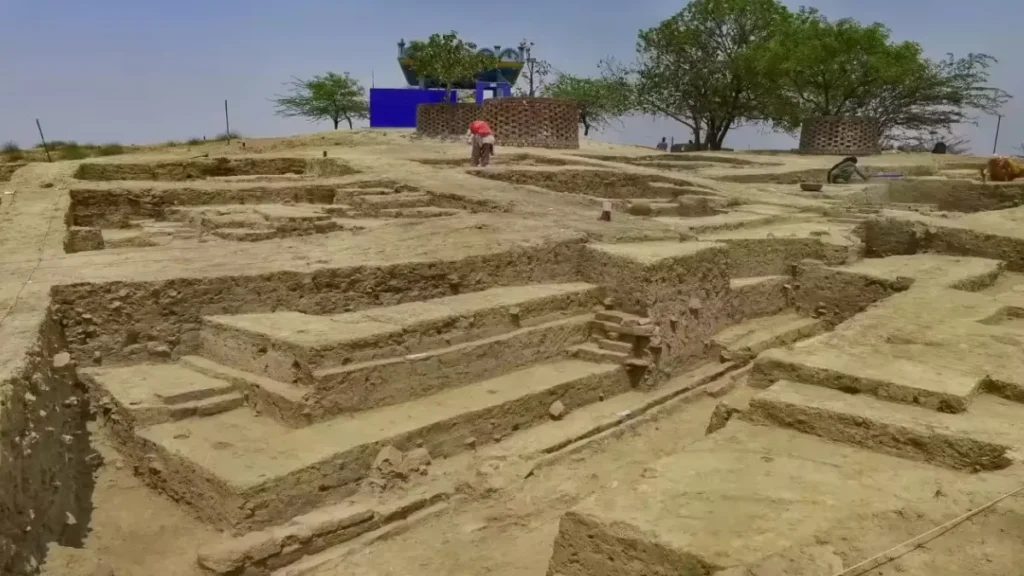
Rakhigarhi is located in Haryana’s Hisar district and is regarded as one of the most important archaeological sites connected with the Indus or Harappan Civilisation.
The site is particularly important because it contains evidence belonging to different stages of the Harappan cultural sequence, including pre-Harappan and mature Harappan phases. Its large geographical spread has also made it one of the most significant settlements associated with the civilisation in the Indian subcontinent.
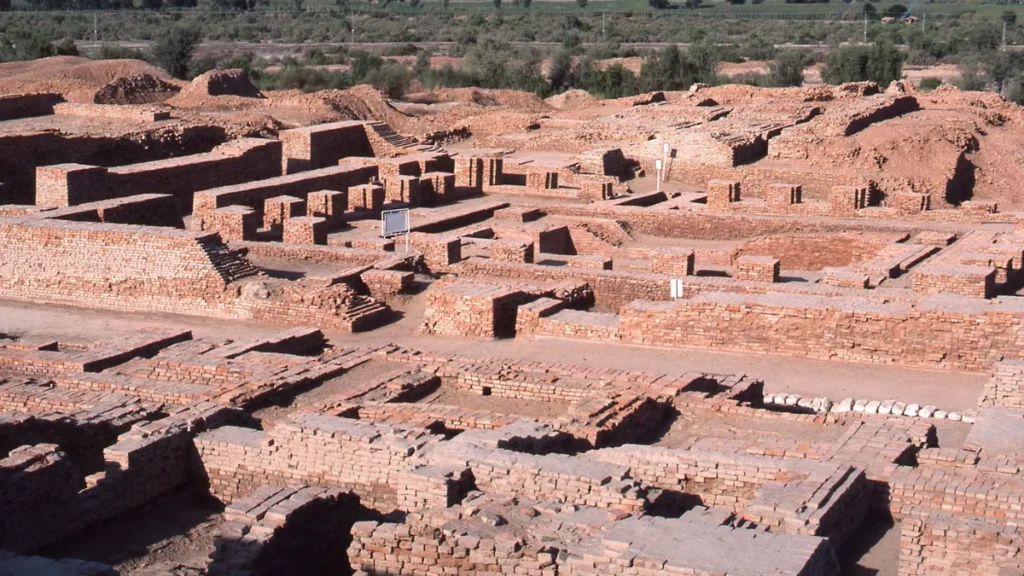
The Indus Valley Civilisation extended across a vast area of present-day India and Pakistan. Some of its best-known urban centres, including Harappa and Mohenjo-daro, are now located in Pakistan. Rakhigarhi, however, is situated in present-day India and provides crucial evidence for understanding the eastern and southern dimensions of the civilisation.
The site lies in the broader Ghaggar-Hakra river system and is roughly 150 kilometres from Delhi. Its archaeological remains cover a substantial area, with estimates placing the settlement complex at more than 300 hectares and, depending on how the archaeological limits are defined, potentially extending beyond that figure.
The scale of Rakhigarhi is one reason archaeologists have paid such close attention to it. It was not simply a small rural settlement. Archaeological evidence indicates a complex settlement with houses, craft activity, drainage arrangements, pottery and other features associated with urban and proto-urban life.
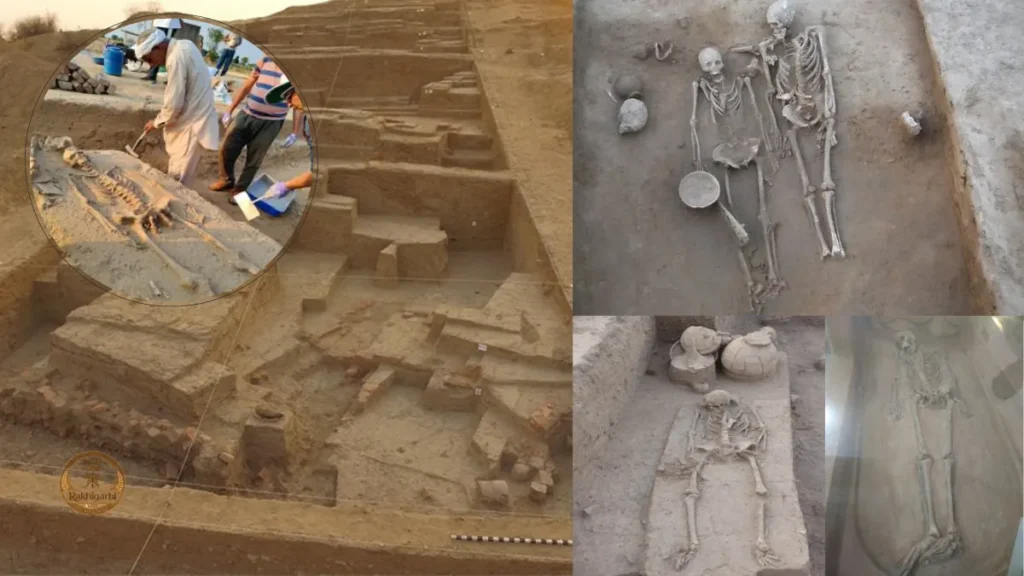
Its importance increased further when researchers began recovering human remains that could potentially provide biological information about the people who lived there.
The Different Phases of Rakhigarhi
Understanding the genetic debate requires first understanding the chronology of Rakhigarhi.
Archaeological investigations and radiocarbon dating have identified multiple phases at the site. Some evidence has been associated with periods preceding the mature Harappan phase, while other material belongs to the early and mature stages of the Harappan cultural tradition.
The dates cited in archaeological studies place some early occupation at Rakhigarhi several thousand years before the mature urban phase of the Indus civilisation. Other layers have been dated to the period when large settlements and sophisticated urban systems were developing across the Harappan world.
The mature Harappan period is generally associated with approximately the third millennium BCE, although the precise chronology varies according to archaeological context and dating methodology.
This distinction is critical when discussing DNA.
A genetic sample from a person who lived around 2500 BCE cannot automatically tell us what the genetic composition of populations in northern India looked like 1,000 years later. Population movements can occur after the individual lived, and genetic ancestry can enter a region at different times.
Therefore, the date of the Rakhigarhi individual is central to understanding what the DNA can and cannot demonstrate.
The Ancient DNA Breakthrough
The genetic research associated with Rakhigarhi attracted considerable international attention because ancient DNA from South Asia is notoriously difficult to recover.
Ancient DNA can be damaged by heat, humidity and other environmental conditions. The Indian subcontinent’s climate presents major challenges for the preservation of genetic material. Consequently, obtaining usable genome-wide data from ancient South Asian remains is scientifically valuable.
A research team including archaeologists and population geneticists studied ancient individuals connected with the Indus Valley Civilisation and neighbouring regions. Their work was published in major scientific journals and became part of a wider effort to reconstruct the genetic history of South Asia.
The Rakhigarhi genome was especially important because it provided direct ancient DNA evidence from a person associated with the Indus Civilisation.
The researchers found that the individual did not possess detectable ancestry from Steppe pastoralist populations.
This result became the basis for a much broader public claim: if the Indus population had no Steppe ancestry, perhaps the theory of migration from the Steppe into South Asia was wrong.
However, that conclusion goes beyond what the individual genome itself can establish.
What the Rakhigarhi Genome Actually Shows
The simplest way to understand the finding is this: the sequenced Rakhigarhi individual belonged to a population with ancestry that was deeply rooted in ancient South Asian genetic history, with additional affinity related to ancient Iranian agricultural populations.
The individual did not display detectable Steppe pastoralist ancestry.
That is an important scientific result.
It indicates that Steppe-related ancestry was not already present in the particular Rakhigarhi individual at the time he or she lived.
But the absence of an ancestry component at one particular point in time does not prove that the same ancestry never entered the region later.
This distinction is essential.
Imagine a population living in a particular region in 2500 BCE. If another population arrives several centuries later, an individual who died in 2500 BCE obviously could not carry ancestry from that later migration.
Consequently, the Rakhigarhi genome needs to be placed within a chronological sequence rather than treated as a genetic snapshot of all later South Asians.
The Rakhigarhi Individual and Haplogroup Evidence
Research on the Rakhigarhi remains identified mitochondrial genetic information associated with a maternal lineage known as U2b2.
Mitochondrial DNA is inherited through the maternal line. Unlike most of the nuclear genome, mitochondrial DNA is passed from mothers to their children, although only women pass it on to the next generation.
Researchers use mitochondrial haplogroups to trace particular branches of maternal ancestry.
The presence of a South Asian-associated mitochondrial lineage in the Rakhigarhi individual is therefore consistent with a population that had longstanding connections to the region.
But mitochondrial DNA represents only one narrow line of ancestry. It does not describe the entire genetic ancestry of an individual.
This is an important point because ancestry is much broader than a single maternal or paternal lineage.
A person’s genome contains contributions from numerous ancestors. A mitochondrial haplogroup traces one maternal line, while a Y-chromosome haplogroup, in males, traces one paternal line. Genome-wide DNA provides a much wider picture of population history.
Therefore, haplogroup evidence is useful, but it should not be confused with a complete description of population ancestry.
What Is a Haplogroup?
A haplogroup can broadly be understood as a genetic branch that represents people who share a common ancestor along a particular lineage.
Scientists identify mutations that accumulated over generations. These mutations allow researchers to organise related lineages into branches and sub-branches.
Mitochondrial haplogroups trace maternal ancestry.
Y-chromosome haplogroups trace paternal ancestry in men.
For example, genetic studies of South Asian populations have identified a variety of mitochondrial and Y-chromosome lineages with different geographical histories.
However, a haplogroup does not mean that an entire population descended exclusively from one ancient group.
Human populations have mixed repeatedly throughout history.
This is why genome-wide analysis is particularly important when reconstructing ancient migration.
Ancient Iran and the Indus Civilisation
One of the most important elements in the genetic history of the Indus population concerns ancient Iranian-related ancestry.
Studies of ancient genomes from regions surrounding South Asia have shown evidence of genetic relationships between populations associated with the Indus region and ancient populations connected to Iran.
This does not mean that the people of the Indus civilisation were simply immigrants from Iran.
Instead, the genetic picture suggests a complex process of population interaction extending over thousands of years.
Ancient populations associated with early Iranian farming communities contributed ancestry to populations that eventually became genetically related to people living in and around the Indus region.
At the same time, South Asian hunter-gatherer-related ancestry was also an important component.
The resulting population was therefore not genetically identical to any single population outside South Asia.
This mixture appears to have developed over a long period.
The 11 Ancient Individuals from Central Asian Sites
Researchers have also examined ancient remains from archaeological sites outside the Indus Valley but connected to the broader cultural and geographical network of ancient Central and South Asia.
Among the sites discussed in genetic research are Gonur in present-day Turkmenistan and Shahr-i-Sokhta in eastern Iran.
Ancient individuals from these sites have provided evidence of genetic relationships with populations associated with the Indus region.
Their genomes indicate a complicated mixture involving ancestry related to ancient Iranian populations and ancestry connected to ancient South Asian populations.
At the same time, these ancient individuals generally did not carry the Steppe ancestry that became more prominent in South Asian populations during later periods.
This distinction again highlights the importance of chronology.
Different populations interacted with South Asia at different times.
Some movements occurred thousands of years before the mature Harappan period. Other movements occurred after the decline of the urban Harappan system.
Treating all these events as one single migration would therefore oversimplify the evidence.
The Steppe Question
The most controversial part of the discussion concerns the Steppe.
The Eurasian Steppe stretches across a huge belt of grassland north of the Black and Caspian seas and extends deep into Central Asia.
Ancient populations living across the Steppe developed mobile pastoral economies and participated in extensive networks of movement and exchange.
Genetic research has established that populations associated with the Steppe contributed ancestry to many later populations across Eurasia.
The key question for South Asian history is when and how Steppe-related ancestry reached the Indian subcontinent.
This is where later ancient DNA becomes extremely important.
The fact that a Rakhigarhi individual from the mature Harappan period lacked Steppe ancestry does not settle the question of whether Steppe-related populations entered South Asia later.
Instead, scientists must compare genomes from different periods.
What Happened After the Mature Harappan Period?
The mature urban phase of the Indus Civilisation began to decline during the second millennium BCE.
This did not mean that the entire population suddenly disappeared.
Archaeological evidence indicates regional transformations, shifts in settlement patterns and changes in material culture.
Different parts of the Harappan world experienced these changes differently.
It was during the broad period after the height of the urban Harappan civilisation that genetic evidence for Steppe-related ancestry becomes increasingly important.
Ancient DNA from later South Asian individuals has provided evidence of ancestry associated with populations connected to the Steppe.
This later evidence is one of the major reasons geneticists argue that some form of population movement from Steppe-related groups into South Asia took place during the second millennium BCE.
Evidence from the Swat Valley
Ancient DNA from the Swat Valley in present-day Pakistan has been particularly important in this discussion.
Individuals associated with archaeological contexts dating to the period after the mature Harappan phase show genetic profiles that contain ancestry components associated with Steppe populations.
This provides a chronological sequence that is different from the Rakhigarhi genome.
Rakhigarhi provides evidence from an earlier period in which Steppe ancestry was not detectable in the individual studied.
Later individuals from northern regions show evidence of ancestry connected to Steppe populations.
The contrast between these samples is scientifically significant.
It suggests that Steppe-related ancestry became part of the genetic landscape of South Asia after the period represented by the Rakhigarhi individual.
This is one of the central reasons why the Rakhigarhi discovery cannot, by itself, be used to declare the Aryan Migration Theory disproved.
When Did Steppe-Related Ancestry Reach South Asia?
The precise date remains a subject of scientific discussion.
Genetic modelling generally places the major movement of Steppe-related ancestry into South Asia during the second millennium BCE.
Different studies have produced somewhat different estimates depending on the populations and genetic models being examined.
The evidence broadly places the relevant population movements after the mature Harappan period and before the establishment of the later genetic patterns visible in many present-day South Asian populations.
This chronology is important.
If Steppe-related ancestry entered South Asia after approximately 2500 BCE, then its absence in a Rakhigarhi individual from around that period is not surprising.
The two pieces of evidence can therefore coexist.
There is no contradiction between saying that a mature Harappan individual did not carry detectable Steppe ancestry and saying that Steppe-related populations later contributed ancestry to South Asian populations.
The Aryan Migration Theory Is More Complicated Than a Single Event
The phrase “Aryan Migration Theory” itself can create confusion.
Older historical discussions sometimes used terms such as “Aryan invasion” to describe a dramatic military conquest of the Indian subcontinent.
Modern scholarship generally does not equate genetic evidence with a single massive invasion.
Population movement can occur through many mechanisms.
Small groups can migrate.
Pastoral communities can move gradually across large territories.
Trade networks can connect populations.
Intermarriage can introduce new ancestry.
Languages can spread through social interaction, elite dominance or population movement.
Therefore, genetic evidence for Steppe-related ancestry does not automatically prove a simple story in which an enormous army invaded India and replaced an existing population.
The genetic record points toward population movement and admixture.
The exact social, political and linguistic consequences of those movements require evidence from archaeology, linguistics and other historical disciplines.
Why the Term “Aryan” Needs Careful Use
Another major issue is the use of the word “Aryan”.
In modern political and popular discourse, the term can carry meanings that differ substantially from its use in historical linguistics.
Ancient Indo-Iranian traditions contain the term arya in particular cultural and linguistic contexts, but this does not mean that there was a biologically pure “Aryan race”.
Modern population genetics strongly contradicts simplistic racial interpretations of ancient populations.
The people who carried Steppe-related ancestry into South Asia were themselves genetically mixed.
Likewise, the populations already living in South Asia were genetically diverse.
Over generations, these groups interacted and mixed with one another.
Therefore, describing the genetic evidence as proof of one “race” replacing another would be scientifically misleading.
The evidence instead points toward population movements followed by admixture.
Rakhigarhi and the Origins of Farming
The Rakhigarhi genome also contributes to another important question: where did agriculture in South Asia originate?
The genetic evidence suggests that the population associated with the Indus civilisation cannot simply be explained as descendants of a large migration of early farmers from Anatolia.
This is important because agriculture developed independently or through different processes in various parts of the ancient world.
South Asian farming traditions appear to have developed through a complicated interaction involving local populations and people with ancestry related to ancient Iranian groups.
The genetic evidence therefore does not support an overly simple model in which farming communities arrived in South Asia directly from Anatolia and established agriculture across the region.
Instead, the formation of the Indus population appears to have involved a distinctive South Asian genetic component combined with ancestry related to ancient populations farther west.
The Difference Between Anatolian and Iranian Ancestry
Another common misunderstanding involves the words “Iranian” and “Anatolian”.
Ancient Iranian-related ancestry found in South Asian populations should not automatically be interpreted as ancestry from modern Iranian people.
Ancient populations were genetically different from modern populations.
Likewise, ancient Anatolian farmers were not identical to modern populations living in Turkey.
Population genetics uses these ancient groups as reference populations because they help scientists model relationships between different prehistoric populations.
The genetic history of South Asia therefore cannot be reduced to modern national boundaries.
Thousands of years ago, populations moved across regions that are now divided among many different countries.
The Long Human History of South Asia
The debate surrounding Rakhigarhi becomes clearer when viewed against the much longer history of human migration.
Modern humans originated in Africa.
Over tens of thousands of years, Homo sapiens expanded into different parts of the world.
Some groups migrated toward the Middle East and eventually into South Asia.
Others moved toward Europe, Southeast Asia and Australia.
These movements did not occur as single journeys undertaken by one generation.
They took place over many generations.
Small populations moved, settled, expanded and interacted with communities they encountered along the way.
Genetic evidence shows that modern humans also interbred with other human groups, including Neanderthals and Denisovans.
The resulting genetic history of modern humanity is therefore the product of repeated migrations, isolation, contact and admixture.
South Asia is no exception.
Early Modern Humans in India
Archaeological and genetic research indicates that modern humans reached South Asia many tens of thousands of years ago.
The exact routes and dates remain subjects of scientific investigation, but genetic lineages found among some South Asian populations preserve evidence of extremely ancient population histories.
The Andaman and Nicobar Islands are especially interesting in this context.
Some Indigenous populations of the islands carry mitochondrial lineages that represent very old branches of human genetic history.
Studies have identified mitochondrial haplogroups such as M31 and M32 among Andamanese populations.
These lineages are deeply rooted in the broader history of the first modern human expansions outside Africa.
Such evidence supports the broader conclusion that modern humans reached South Asia during the early stages of the global expansion of Homo sapiens.
But these ancient migrations should not be confused with later population movements.
Human history consists of multiple waves of migration.
The Ancient South Asian Genetic Component
Population geneticists use terms such as Ancient Ancestral South Indian-related ancestry to describe one of the deep ancestral components found in present-day South Asian populations.
This ancestry is not equivalent to a modern ethnic group.
It represents a reconstructed ancestral population or genetic component.
Similarly, ancient Iranian-related ancestry represents another component that entered into the formation of populations associated with the Indus region.
Over time, these ancestral components combined in different proportions across South Asia.
The resulting genetic landscape was highly diverse.
This diversity helps explain why present-day South Asian populations cannot be traced to one single ancient population.
The Formation of the Indus Population
Genetic modelling indicates that the population associated with the Indus Civilisation emerged through a long process of admixture.
A deep South Asian ancestry component combined with ancestry related to ancient Iranian populations.
This population eventually became one of the major ancestral sources for later South Asians.
That finding makes the Rakhigarhi genome especially valuable.
It provides direct evidence for the existence of a population in the Indus region that already possessed a genetic profile shaped by long-term interactions between populations from different parts of South Asia and the Iranian plateau.
The evidence therefore strongly supports the idea that the Indus Civilisation was not created by a single outside population.
Its people had deep roots in the region.
But deep local ancestry does not rule out later migration.
Both facts can be true simultaneously.
The Timing Is the Key
The most important issue in interpreting Rakhigarhi is chronology.
The individual whose genome was successfully analysed lived during the mature Harappan period.
The Steppe-related population movement identified in later genetic studies appears to have occurred after that period.
Consequently, the Rakhigarhi individual represents a population before the major appearance of Steppe-related ancestry in the South Asian genetic record.
This is similar to studying an ancient city before a later migration and then concluding that the migration never happened simply because the earlier population did not carry the migrants’ ancestry.
The correct scientific approach is to compare individuals from before, during and after the suspected period of migration.
That is precisely what the broader ancient DNA record allows researchers to begin doing.
One Genome Cannot Represent an Entire Civilisation
Another crucial limitation is sample size.
Only a very small number of ancient South Asian genomes have been successfully recovered compared with the enormous number of people who lived in the region over thousands of years.
Even at Rakhigarhi, archaeological investigations recovered remains from numerous individuals, but obtaining sufficiently preserved DNA for genome-wide sequencing was exceptionally difficult.
The successful sequencing of one individual was therefore an important scientific achievement.
But one genome cannot represent every person who lived at Rakhigarhi.
Nor can it represent every population belonging to the Indus Civilisation.
Large civilisations are genetically heterogeneous.
Different settlements may have had different demographic histories.
People moved between communities.
Marriage networks connected distant regions.
Some settlements may have received migrants while others did not.
Therefore, conclusions about an entire civilisation require multiple samples from multiple locations and periods.
What the Genetic Record Says About Later South Asians
The genetic picture becomes more informative when ancient genomes are compared with present-day South Asian populations.
Modern South Asians carry ancestry from several ancient sources.
One major component is related to populations that formed within the Indus-related genetic landscape.
Another important component is associated with later Steppe populations.
The proportions vary considerably between populations and regions.
This variation itself is evidence of a complicated demographic history.
If a single migration had completely replaced the earlier population, we would expect a very different genetic pattern.
Instead, the evidence indicates admixture.
Groups that arrived later mixed with populations already living in South Asia.
Their genetic contribution was subsequently passed through generations.
The Importance of Paternal Lineages
Y-chromosome evidence has also been central to discussions of Steppe-related ancestry.
Unlike mitochondrial DNA, which traces maternal ancestry, the Y chromosome is passed primarily from fathers to sons.
Certain Y-chromosome lineages became widespread across parts of Eurasia during the Bronze Age.
Some branches of haplogroup R, particularly R1a lineages, are found at high frequencies in many modern South Asian populations and also occur across parts of Europe and Central Asia.
However, the distribution of a modern haplogroup alone cannot prove a specific migration.
Researchers need ancient DNA, archaeological chronology and population-genetic modelling to determine when and where particular branches expanded.
The most useful evidence therefore comes from combining Y-chromosome data with genome-wide ancestry.
Why R1a Alone Does Not Solve the Debate
Public discussions sometimes treat R1a as an “Aryan gene”.
That description is scientifically inaccurate.
R1a is a large Y-chromosome haplogroup containing multiple branches.
It is not exclusive to one language, religion, ethnicity or historical population.
Different branches of R1a have different geographical histories.
Some became common in Eastern Europe and Central Asia, while others became particularly widespread in South Asia.
Ancient DNA studies have helped researchers trace the development of these branches.
The relevant question is not whether R1a exists in India.
It clearly does.
The question is when particular branches arrived, expanded and mixed with existing populations.
That requires detailed genetic chronology.
Migration Does Not Mean Replacement
One of the most common misconceptions surrounding the Aryan migration debate is the assumption that migration means replacement.
Human migration does not necessarily involve population replacement.
A relatively small incoming population can contribute language, cultural practices and genetic ancestry without becoming the majority of the population.
This is common in human history.
Languages can spread beyond the demographic size of their original speakers.
Genetic admixture can occur gradually.
Cultural influence can spread through trade, marriage and political networks.
The genetic evidence for Steppe ancestry in South Asia is therefore compatible with a scenario involving migration and admixture rather than wholesale population replacement.
Archaeology and Genetics Must Be Read Together
Genetics cannot answer every historical question.
DNA can reveal biological relationships and population movements.
Archaeology provides evidence about settlements, technology, trade, burial practices, food production and material culture.
Linguistics provides evidence about relationships between languages.
Historical traditions can provide additional, although much later and often difficult-to-date, information.
The strongest historical reconstruction emerges when these different lines of evidence are compared.
A genetic result should therefore not be isolated from archaeology.
Likewise, archaeological similarities alone cannot establish biological ancestry.
This interdisciplinary approach is particularly important for South Asian prehistory.
What Rakhigarhi Does Disprove
The Rakhigarhi evidence does challenge several simplistic versions of the migration story.
It does not support the idea that the Indus population was simply a transplanted group of Steppe pastoralists.
It also does not show that a large Steppe population was already living at Rakhigarhi during the mature Harappan period.
The evidence further supports the conclusion that the population associated with the Indus civilisation had substantial ancestry rooted in South Asian and ancient Iranian-related populations.
These are significant findings.
But they are different from proving that no later migration ever took place.
What Rakhigarhi Does Not Disprove
The Rakhigarhi genome does not demonstrate that Steppe-related populations never entered South Asia.
It does not explain the later appearance of Steppe-related ancestry in ancient individuals from northern parts of the subcontinent.
It does not eliminate the evidence from later ancient genomes.
And it cannot by itself explain the spread of Indo-European languages into South Asia.
Those are separate historical questions that require evidence from later periods.
Therefore, the statement that “Rakhigarhi proved the Aryan Migration Theory was a myth” goes beyond what the genetic evidence can legitimately establish.
The Difference Between Migration and Invasion
There is also a major difference between the terms “migration” and “invasion”.
The older “Aryan Invasion Theory” often imagined a large-scale military invasion that destroyed the Indus civilisation and imposed a new culture.
Modern genetic research does not require such a scenario.
The genetic evidence is much more consistent with movement of populations and subsequent admixture.
The archaeological record also does not provide a straightforward picture of a single catastrophic invasion that destroyed every Harappan settlement.
The decline of the urban Harappan system appears to have involved environmental, economic and demographic factors.
Different regions followed different trajectories.
Therefore, rejecting an old invasion model does not necessarily mean rejecting all evidence for later migration.
These are two separate propositions.
Did Indo-European Speakers Enter South Asia?
Genetic evidence strongly supports some movement of populations related to Steppe groups into South Asia during the second millennium BCE.
The relationship between that ancestry and the spread of Indo-European languages is an important part of current research.
The genetic chronology broadly overlaps with linguistic models that place the diversification and movement of Indo-Iranian languages in the wider Central and South Asian region during the Bronze and early Iron Ages.
But genetics cannot identify the language spoken by an individual skeleton.
DNA does not contain a label saying “this person spoke Sanskrit” or “this person spoke an Indo-European language”.
Scientists therefore infer possible relationships by comparing genetic, archaeological and linguistic evidence.
This is why careful wording matters.
The genetic evidence supports population movement. The linguistic interpretation is then built by combining several independent lines of evidence.
A Timeline Helps Explain the Evidence
A simplified timeline makes the argument easier to understand.
The earliest modern humans reached South Asia tens of thousands of years ago.
Much later, populations related to ancient Iranian agricultural communities interacted with South Asian populations.
These interactions contributed to the genetic ancestry of populations associated with the Indus civilisation.
By the mature Harappan period, represented at Rakhigarhi by the sequenced individual, Steppe-related ancestry was not detectable in that individual.
The urban Harappan system subsequently underwent major transformation.
During the second millennium BCE, Steppe-related ancestry appears in ancient South Asian genetic samples.
Over subsequent centuries, this ancestry mixed with existing populations.
Modern South Asians therefore inherited ancestry from several ancient population sources.
Seen in this sequence, the Rakhigarhi genome and later Steppe ancestry are not mutually exclusive.
Why the Rakhigarhi Discovery Remains So Important
Even if it does not single-handedly settle the Aryan migration debate, Rakhigarhi remains one of the most important sites for understanding South Asian prehistory.
Its archaeological record provides evidence of the development of complex settlements in the Indian subcontinent.
Its human remains provide an opportunity to study the biological history of the people who lived there.
Its ancient DNA contributes directly to questions about population formation.
Most importantly, Rakhigarhi demonstrates that the genetic history of South Asia cannot be reduced to a simple story of people arriving from one external region and creating civilisation from scratch.
The people of the Indus world had deep local ancestry.
Their population history was shaped by interactions with neighbouring regions over thousands of years.
Later populations added further layers to that history.
The Larger Lesson From Ancient DNA
The most important lesson from Rakhigarhi may be that ancient DNA makes historical narratives more complicated rather than simpler.
Genetics rarely provides a single sentence as an answer.
Instead, it reveals layers.
A population can have deep local ancestry and later receive migrants.
A migrant group can contribute ancestry without replacing the existing population.
A cultural tradition can survive after a demographic transformation.
A language can spread farther than the people who originally spoke it.
And a civilisation can decline without its population disappearing.
These realities make ancient history more difficult to turn into simple political slogans.
They also make it more scientifically interesting.
Why More Ancient DNA Is Needed
The biggest limitation in the current debate is the relatively small number of high-quality ancient genomes from South Asia.
Climate and preservation conditions have made ancient DNA recovery difficult.
Researchers therefore need more samples from different archaeological sites and different chronological periods.
Future discoveries from Haryana, Punjab, Rajasthan, Gujarat, Uttar Pradesh, Pakistan, Afghanistan and neighbouring Central Asian regions could provide a much clearer picture.
Samples from both men and women will be valuable.
Genome-wide data will be particularly important because mitochondrial and Y-chromosome lineages represent only individual lines of descent.
With larger datasets, scientists can identify population movements with greater precision.
The Need for Caution in Political Claims
Because the history of the Indus Civilisation and the Aryan migration debate has political and cultural significance, scientific findings are often presented in highly simplified terms.
A headline may claim that one discovery “ends the debate”.
Another may claim that a particular DNA result “proves” an entire historical theory.
Neither approach is ideal.
Science develops through comparison, replication and additional evidence.
The Rakhigarhi genome was an important breakthrough, but it should be interpreted alongside later ancient DNA, archaeology and linguistics.
Likewise, evidence for Steppe-related ancestry should not be turned into a claim that the entire Indus civilisation was foreign or that its population disappeared.
The scientific picture is considerably more nuanced.
So, Has Rakhigarhi Disproved the Aryan Migration Theory?
Based on the evidence described above, the answer is no.
The Rakhigarhi genome does not show detectable Steppe ancestry in the individual who was sequenced.
That finding is real and scientifically important.
It demonstrates that the Steppe ancestry associated with later South Asian populations was not already detectable in that particular individual during the mature Harappan period.
However, later ancient DNA from South Asia provides evidence of Steppe-related ancestry entering the region after the period represented by Rakhigarhi.
This later ancestry became part of the genetic makeup of many South Asian populations through admixture.
Therefore, the Rakhigarhi finding cannot be used on its own to disprove later population movement.
Instead, it helps establish a chronological boundary.
It shows what at least one Indus individual looked like genetically before the later appearance of substantial Steppe-related ancestry in South Asian ancient DNA.
The Evidence Points to Multiple Migrations
The genetic history of South Asia is best understood as a sequence of population movements rather than one single migration.
The first major migration involved modern humans leaving Africa and eventually reaching South Asia.
Later, populations related to ancient Iranian groups contributed ancestry to communities that became associated with the Indus Civilisation.
The Indus population subsequently developed its own distinctive genetic profile.
After the mature Harappan period, Steppe-related populations contributed additional ancestry.
These movements occurred over thousands of years.
No single event explains the entire genetic history of India.
The Indian subcontinent has always been a meeting place of populations.
Its genetic diversity is the product of repeated interaction between communities that arrived at different times and from different directions.
Rakhigarhi as a Piece of a Much Larger Puzzle
Rakhigarhi should therefore be understood not as the final word on ancient Indian history but as one of the most valuable pieces of evidence available.
Its archaeological remains demonstrate the antiquity and complexity of the Indus cultural tradition in present-day India.
Its genetic evidence provides a window into the ancestry of at least one person who lived during the mature Harappan period.
The absence of Steppe ancestry in that genome is significant.
But later genetic evidence changes the picture.
Together, the data suggest that the population associated with the Indus Civilisation had a substantial ancestry rooted in South Asia and ancient Iranian-related populations, while Steppe-related ancestry entered South Asia later.
That conclusion does not diminish the importance of Rakhigarhi.
If anything, it makes the site more important.
It helps researchers distinguish between different phases of South Asian population history.
A More Accurate Way to Describe the Finding
Instead of saying that Rakhigarhi “destroyed” the Aryan Migration Theory, a more scientifically accurate description would be that the Rakhigarhi genome challenged simplistic versions of the theory and provided direct evidence about the genetic makeup of an Indus population before the later appearance of substantial Steppe-related ancestry in South Asia.
That distinction matters.
The genetic evidence does not support a simplistic story in which outsiders arrived and created the Indus civilisation.
Nor does it support the idea that later population movement into South Asia never occurred.
Both the deep local ancestry of Indus populations and later Steppe-related admixture can be part of the same history.
What Future Discoveries Could Change
Ancient DNA research is still developing rapidly.
Every newly sequenced individual has the potential to refine existing models.
Future discoveries could reveal that certain migrations happened earlier or later than currently estimated.
They could show that different parts of South Asia experienced different levels of Steppe-related ancestry.
They could also clarify the relationship between populations in the Indus region, Central Asia and the Iranian plateau.
More archaeological excavations and better preservation techniques could eventually provide hundreds of additional ancient genomes.
Such evidence could transform our understanding of the Bronze Age in South Asia.
That is why it is too early to treat any single genome as the final answer.
The Scientific Picture So Far
The available evidence can be summarised in several broad points.
First, Rakhigarhi was a major settlement associated with the Indus Valley Civilisation and contains evidence from multiple stages of the Harappan cultural sequence.
Second, researchers successfully obtained genome-wide information from at least one individual associated with the site.
Third, that individual did not show detectable ancestry from Steppe pastoralist populations.
Fourth, the individual’s genetic profile was connected to ancestral populations associated with South Asia and ancient Iranian-related groups.
Fifth, later ancient DNA from South Asia provides evidence of Steppe-related ancestry.
Sixth, modern South Asian populations contain varying proportions of ancestry derived from several ancient population sources.
Seventh, the genetic evidence is more consistent with population movement and admixture than with a simplistic model of total population replacement.
Finally, the Rakhigarhi genome cannot by itself disprove later migration into South Asia.
The Bigger Historical Picture
The story emerging from Rakhigarhi is therefore not one of a civilisation isolated from the rest of the ancient world.
Nor is it a story of a civilisation created entirely by outsiders.
It is a story of interaction.
Ancient South Asia was connected to regions stretching from the Iranian plateau to Central Asia and beyond.
People, goods, technologies and genes moved through these networks at different times.
Some populations settled permanently.
Others disappeared or were absorbed.
Some cultural traditions survived for centuries after demographic changes.
The Indus Civilisation itself emerged from a long process of regional development and interaction.
Its people were part of a much larger Eurasian world.
Also read: Rakhigarhi Harappan Civilization: Tooth Study Reveals Possible Changes in Ancient Food Habits
Conclusion: What Rakhigarhi Really Tells Us
The discovery of ancient DNA at Rakhigarhi is undoubtedly one of the most important developments in the study of the Indus Valley Civilisation.
It provides direct genetic evidence from an individual who lived during the mature Harappan period and shows that this person did not carry detectable Steppe pastoralist ancestry.
That finding is crucial because it demonstrates that the Steppe-related genetic component visible in many later South Asian populations was not already present in the individual studied at Rakhigarhi.
But the story does not end there.
Later ancient DNA provides evidence that Steppe-related ancestry entered South Asia during the second millennium BCE and subsequently mixed with populations already living in the region.
This means that the absence of Steppe ancestry at Rakhigarhi cannot, by itself, disprove the possibility of later migration.
At the same time, the Rakhigarhi evidence strongly challenges any simplistic claim that the Indus Valley Civilisation was established by Steppe migrants.
The genetic picture points instead to a population with deep South Asian ancestry and important genetic connections to ancient populations associated with the Iranian plateau.
The history that emerges is therefore much more complex than either extreme version of the debate suggests.
Rakhigarhi does not provide evidence that the entire Aryan migration narrative is simply a “myth”. Nor does it support an old-fashioned picture of a massive foreign invasion sweeping across India and replacing its people.
What the evidence supports is a more nuanced model of ancient population history: early modern human settlement, later interaction with populations related to ancient Iranian groups, the development of the Indus population, the transformation of the Harappan civilisation and, subsequently, the arrival and admixture of Steppe-related ancestry.
The exact relationship between these population movements and the spread of Indo-European languages remains an important subject of research.
What is increasingly clear, however, is that ancient South Asian history cannot be explained by a single migration, a single population or a single genetic lineage.
The people of the Indus Civilisation had deep roots in South Asia. Later populations also arrived and contributed to the ancestry of people living in the region today.
Both facts can be true at the same time.
That is perhaps the most important lesson of the Rakhigarhi discovery.
Rather than closing the debate, the ancient DNA evidence has made the question more precise. It has shifted the discussion away from broad claims about whether one group “was Indian” or “came from outside” and toward more meaningful scientific questions: when did different populations move, where did they come from, how large were those movements, whom did they meet, and how did their descendants become part of the diverse populations of South Asia?
Those questions cannot be answered by one skeleton alone.
They require archaeology, genetics, linguistics, chronology and continued excavation.
Rakhigarhi has provided an extraordinary piece of that evidence. The next pieces will come from other archaeological sites, other ancient genomes and future research.
For now, the scientific record points to a complicated but increasingly understandable history: the Indus people were not simply migrants from the Steppe, yet later Steppe-related population movement into South Asia is supported by genetic evidence.
The real significance of Rakhigarhi lies precisely in this distinction. It gives researchers a clearer view of the people who lived in the Indus world before later genetic changes reshaped the ancestry of South Asian populations.
And rather than reducing India’s ancient history to a single answer, Rakhigarhi reminds us that the history of human populations is almost always a story of movement, settlement, interaction and mixture across generations.